Canal tomb D, E, F and G
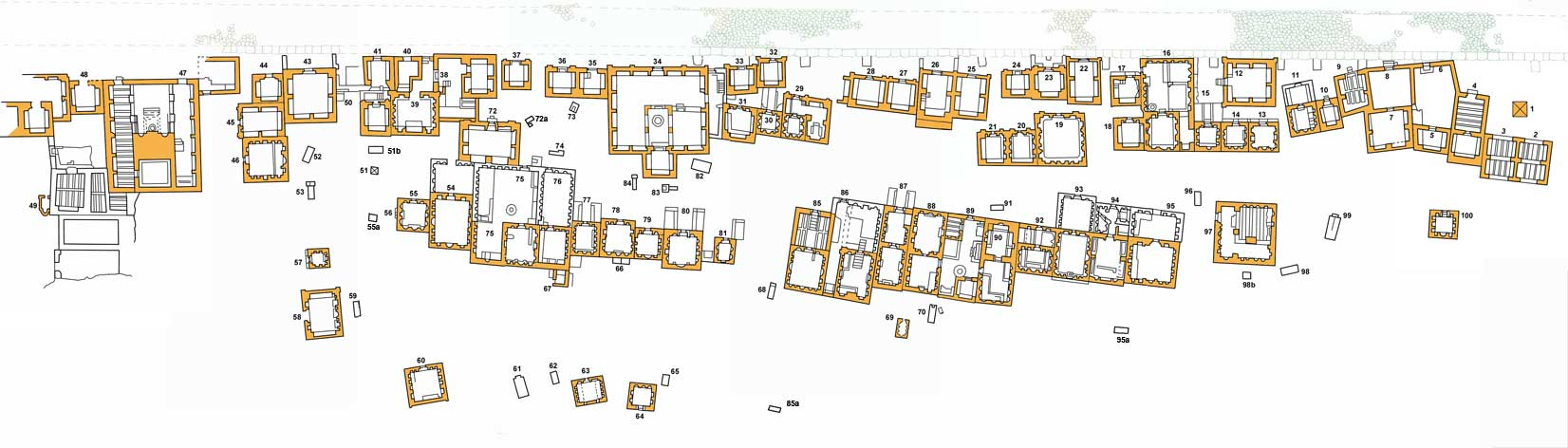
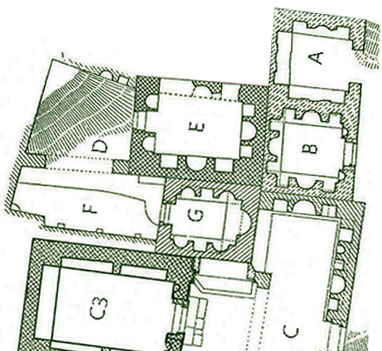 Tombs D, E, F and G could be entered from the north-west side via a parallel road of the main street (not excavated). Only tomb D hd an entrance on the street. The other three tombs had to be entered from tomb D. According to Guido Calza this was also the situation in antiquity.
Tomb D, covered with earth again, was probably the enclosure of tomb E, while tomb F was the enclosure of burial chamber G (see plan). Tombs D and E seem to be much older than the other tombs.
The north-east wall of tomb D is made of large, thick bricks. In this wall was a central niche flanked by four smaller ones.
Tomb E, on the contrary, was built of small elegant bricks, had a door with jambs, a travertine architrave and a framed inscription with two small slit windows.
The inscription above the burial chamber of tomb E measures 140 x 50 cm:
D(is) M(anibus)
TI(berius) CLAVDIVS TI(beri) FIL(ius) IVLIANVS
FECIT SIBI ET CLAVDIAE DONATAE
MATRI CARISSIMAE ET TI(berio) CLAVDIO DEME
TRIO FRATRI CARISSIMO QVI VIXIT ANNIS XXI MEN
SIBVS VIII DIEBVS XIIII ET CLAVDIAE IULIANE
FILIAE DVLCISSIMAE ET LIBERTIS LIBERTABVS
POSTERISQVE EORVM IN FR(onte) P(edes) XIII IN AGR(o) [---]
The inscription tells us that Tiberius Claudius Julianus, son of Tiberius, has built this monument for himself and for Claudia Donata, his dearest mother and for Tiberius Claudius Demetrius, his dearest brother, who lived twenty-one years, eight months and fourteen days, and for Claudia Juliana, his very sweet daughter, and for his freedmen and freedwomen, and the descendants. The area measures thirteen feet in width and in depth ... .
With the exception of the damaged north-eastern wall, the vault of tomb E was found almost intact, and on top several original roof tiles have been found.
Inside the burial chamber is a small square niche between the slit windows of the entrance wall. The door was flanked by four semicircular niches. Inside each niche was room for five urns.
The other three walls of tomb E have a group of niches each: one big central niche, flanked by two smaller ones. All niches have a semicircular top. The original paintings have disappeared.
Each side wall has two arcolsolia below the niches, the back wall one arcosolium.
From tomb D one could enter tomb F through a large archway. Tomb F was a vaulted room, almost completely covered with a sloping floor of which we can still see parts in the corners. The floor seems to have covered graves.
The entrance of tomb G has a door with travertine jambs and an architrave, but no inscription. Inside the tomb we find three arcosolia, which were painted in their vaults. In the arcosolium of the back wall a duck and a bird were still recognizable during the excavations.
Above the arcosolia of the side walls are two groups of three niches. The one in the middle is square, the other two are semicircular. The niches are flanked by small brick colums supporting a tympanum.
Back to introduction Canal Tombs
- Sources
- Russel Meigs - Roman Ostia, At the Clarendon Press 1973
- Guido Calza - Necropoli nell'Isola Sacra'(1940)
- Dr. Jan Theo Bakker.
Waardeert u ons werk?
Wordt lid van Roman Ports en ontvang het boek of doe een donatie!
 Wordt lid en steun ons
Ostia, leverancier of marktplaats van Rome
De veranderende economische rol van Ostia na de aanleg van Portus in het licht van nieuw archeologisch bewijs.
Lees meer...Carthago Nova, de perfecte haven van de (nieuwe) nieuwe-stad
Na de dood van Hasdrubal werd zijn neef Hannibal opperbevelhebber van de Carthaagse strijdkrachten in Hispania....
Lees meer...Isola Sacra Index (N)
Speciale sectie over de Romeinse begraafplaats van Portus (Engels)....
Lees meer...De teruggevonden vloot van Pisa
In 1998 werd bij toeval een ongelooflijk archeologisch erfgoed ontdekt in de buurt van het station Pisa San Rossore....
Lees meer...Leptiminus
Op de plaats van het huidige Lamta aan de oostkust van Tunesië lag al in de oudheid een havenstad met de naam Leptis Minor ....
Lees meer... We are committed to providing versions of our articles and interviews in several languages, but our first language is English.