Adapted from a message of MEDITERRANEO ANTICO (3 augustus 2016)
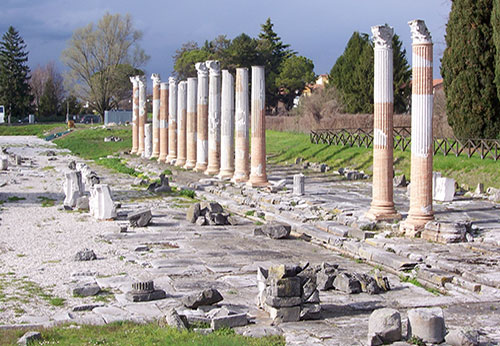
Between March and July of this year a group of specialised students, scientists and others has explored the ancient Roman port city of Aquileia on the Adriatic coast in northern Italy. The research of the city from 181 BC was done under the superintendence of professor Monica Salvadori and professor Andrea Raffaele Ghioto in cooperation with the ‘Foundation Aquileia’.
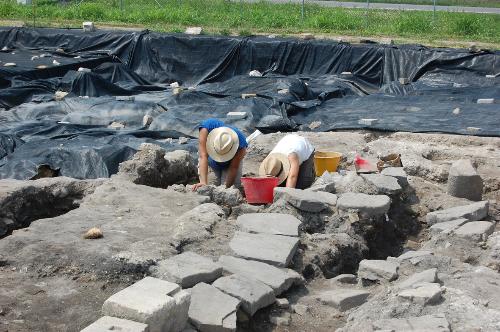
The excavations, on a yearly base already started in 2007, shows the development of a residential area of the old city over a time of 500 years (from the end of the 1e century BC till the 5e century AD). In 2013 the excavations were expanded to the western part were a complete new residential area was found. The aim of the campaign of 2016 was to map out the complete geometrical plan of this area.
This year the research contained two specific locations.
The first one was the Domus delle Bestie Ferite (the house of the wounded animals), a rich large private house with a large mosaic floor depicting wounded animals. Although we have to wait for the official results it’s already clear that the building history of the domus can be divided into two eras, the Augustin period and the late antique period. During the second period the house was partly demolished to make place for an impressive apse containing a large marble floor and a paved open-air area, probably surrounded by a colony.
(photo Meditteraneo Antico)
The second location was in a public area between the Forum and the Large Thermae. Here a series of prospective geophysical surveys was done under superintendence of engineer Rita Deiana. According to the old hypothesis of Luisa Bertacchi this should be the location of an old theatre.
In 2015 already there was some evidence of the theatre and this year they tried to understand the complete plan of this theatre. The researchers investigated traces of a series of long, strong radially wall structures marked on two places with a curved wall. These kind of structures are typically for the base structure of the cavea (spectators stand) of ancient Roman theatres. The cross walls ended at the outside with a pillar. As it looks now the diameter of the cavea amounted to 100 meter.
In spring next year the work will continue .
Translated by Roman Ports.
 We are committed to providing versions of our articles and interviews in several languages, but our first language is English.