In recent years, several articles have appeared in Roman Ports about Ostia as the official port of Rome. We have also shown how, over time, most port activities were taken over by the nearby newly built harbours of Claudius and Trajan. One of the questions that remains unanswered is what role Ostia ultimately played after those harbours came into use.
The German archaeologist Prof. Dr. Michael Heinzelmann, affiliated with the University of Cologne, has conducted numerous research campaigns in Ostia and wrote a paper on this subject for the XVII International Congress of Classical Archaeology, held in Rome on 22-26 September 2008. The editors of Romanports.org consider this study so interesting that we would like to share it with you. Supplier of Rome or marketplace of the Mediterranean? The changing economic role of Ostia after the construction of Portus in the light of new archaeological evidence.
By Michael Heinzelmann
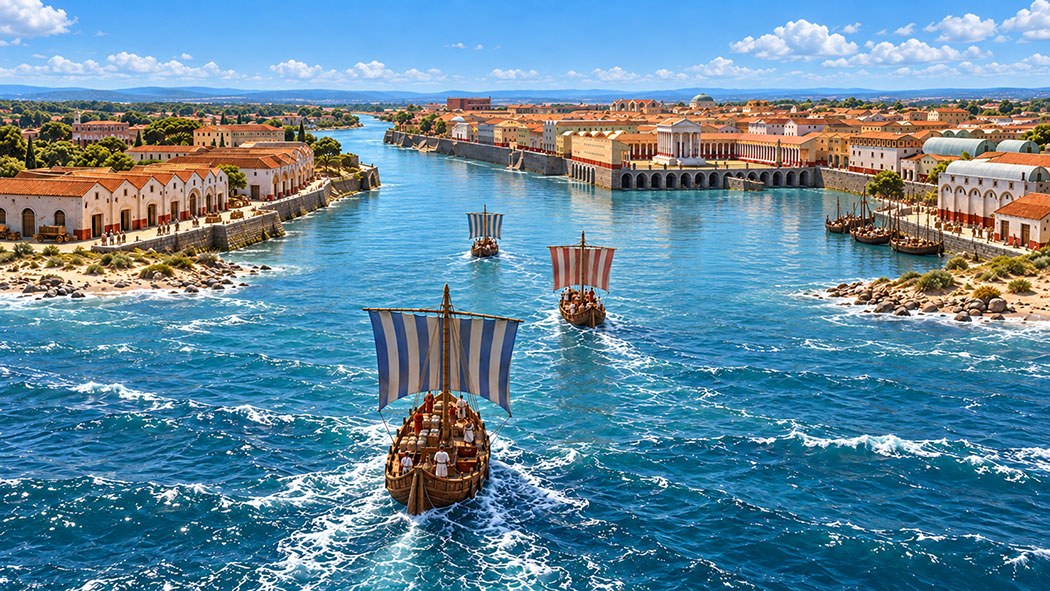
This article aims to stimulate discussion about the economic role of Ostia in the second century AD and the city's relationship with Portus and Rome. Contrary to the traditional view, my main argument is that during this period Ostia served only partly as a supplier of Rome - a task successfully taken over by Portus - and earned a large proportion of its income as an important centre for intermediary trade in the Mediterranean.[1]
My starting point is the urban development of Ostia as we can reconstruct it from recent research in Ostia and Portus and the results of our own project in the unexcavated parts of the city, using geophysical surveys, aerial photography and stratigraphic excavations.[2]
In the first part, I summarise some of the most important phases in Ostia's development; in the second part, I present some more general thoughts on the city's economic role. Ostia initially developed only slowly after its foundation at the end of the fourth century BC as a fortress controlling the river mouth, with a small number of settler families.
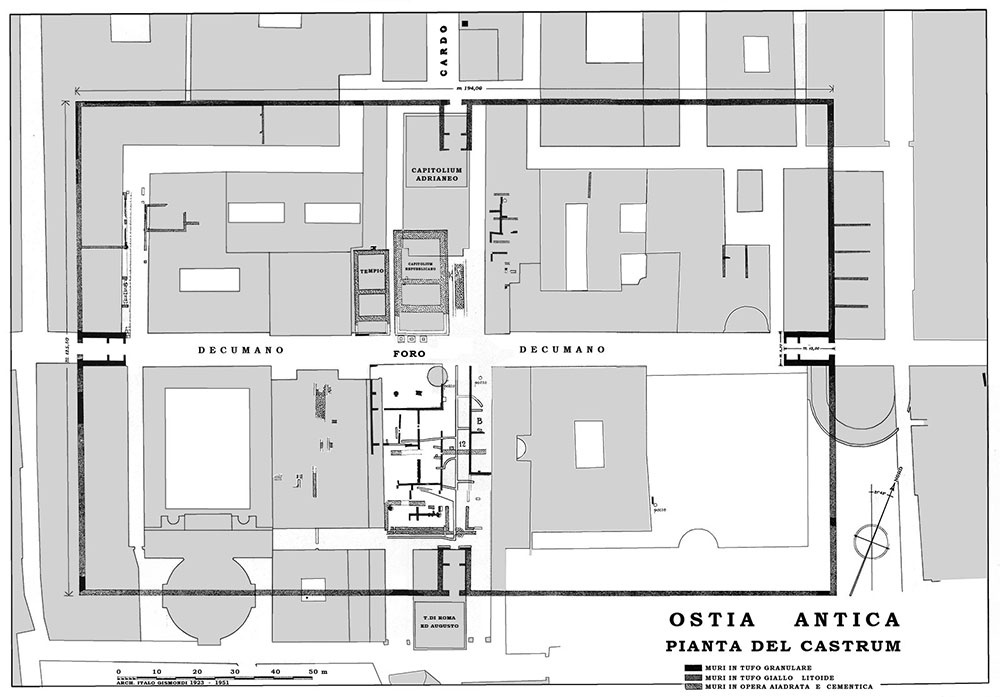
Although Ostia gradually grew beyond the walls of the castrum1 and expanded without planning along the roads leading out of it, until the end of the Republic its size and infrastructure retained the appearance of a small town, almost a village. The reason for this remarkably slow development was probably the lack of a suitable harbour. Most goods from the eastern Mediterranean destined for Rome arrived through the harbour of Puteoli on the Bay of Naples.
However, I am no longer convinced that seagoing ships could not enter the mouth of the Tiber, as has traditionally been assumed.
Recent geoarchaeological research2 shows that in antiquity the river was approximately five to six metres deep and that the water level of the Tiber probably did not fall below three to four metres even during the dry summer season, when most maritime traffic arrived.[3] This means that most Roman ships, which usually carried 200 to 400 tonnes of cargo, could easily enter the mouth of the Tiber throughout the year.
The river harbour did, however, have a major logistical problem. Because of the current, ships had to moor parallel to the bank. Given the length of the settlement, this meant that no more than about twenty ships could be unloaded at the same time. Unloading an average-sized ship with approximately 250 tonnes of cargo is estimated to have taken six to eight days. The risk of a ship arriving in Ostia during the peak season and finding no available berth must therefore have been considerable. In my opinion, we must therefore recognise that Ostia was an ordinary river harbour, like hundreds of others around the Mediterranean, but that its capacity was simply insufficient for the enormous quantities of goods Rome needed every day.
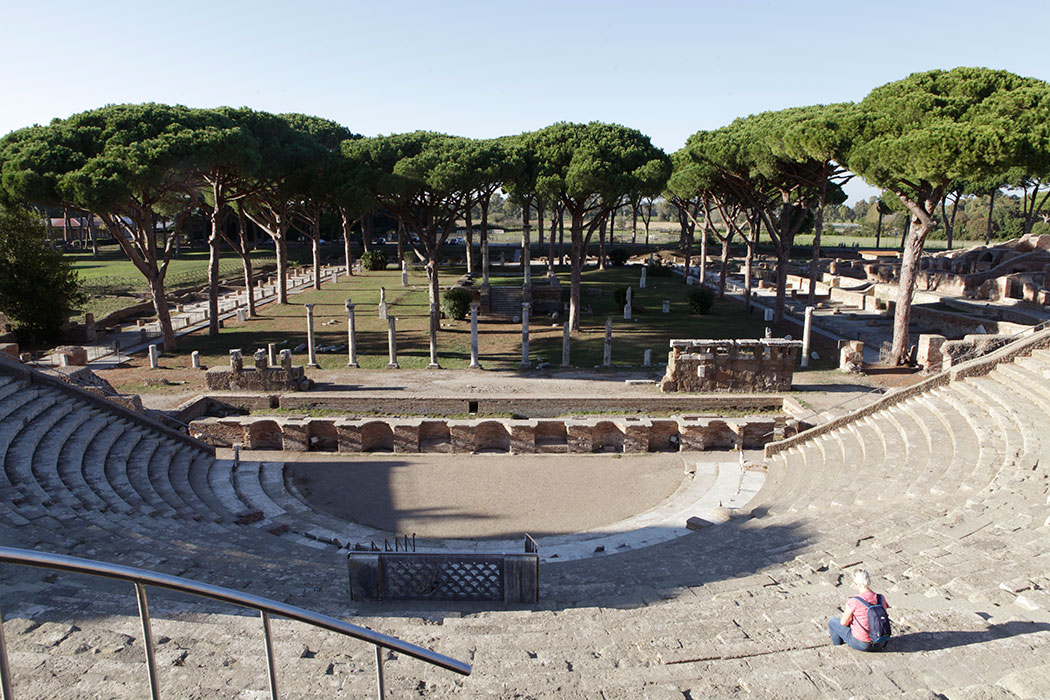
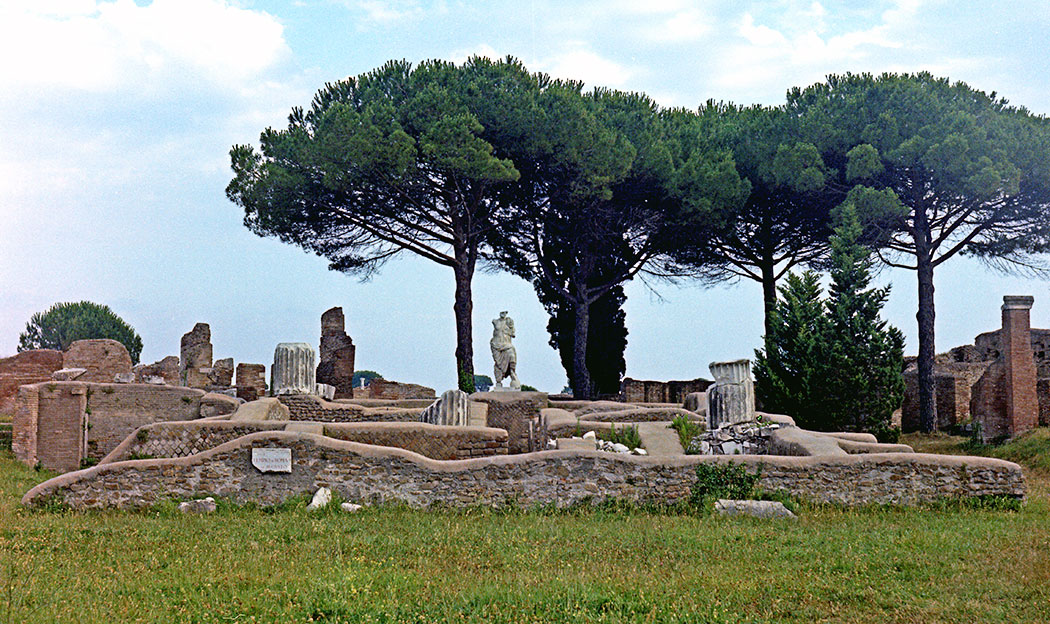
It is well known that, from Augustus onwards, the emperors took a particular interest in improving this situation, either through administrative measures or through investment in infrastructure. The urban development of Ostia did indeed become considerably more dynamic during the Julio-Claudian period, when the built-up area expanded mainly westwards, towards the coast. At the same time, major urban development projects were carried out within the city that can be attributed, at least in part, to the direct involvement of the imperial household or its immediate circle. Examples include Agrippa's construction of the theatre and the construction of the Piazzale delle Corporazioni, the expansion of the forum and the construction of the temple of Roma and Augustus.
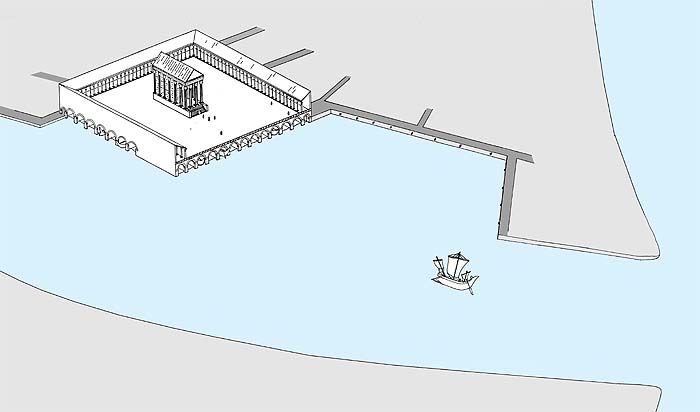
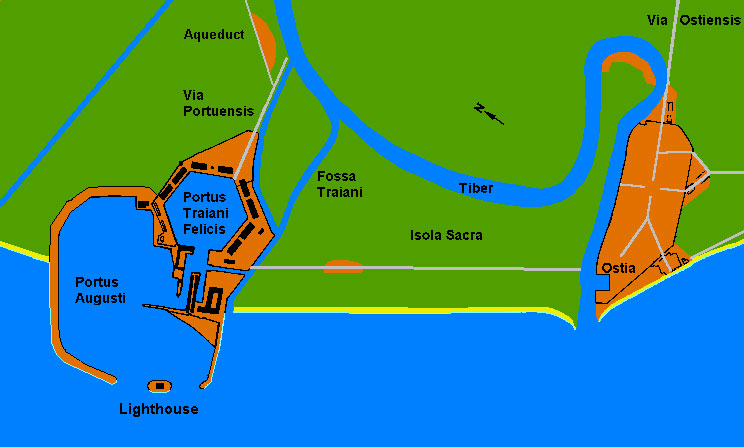
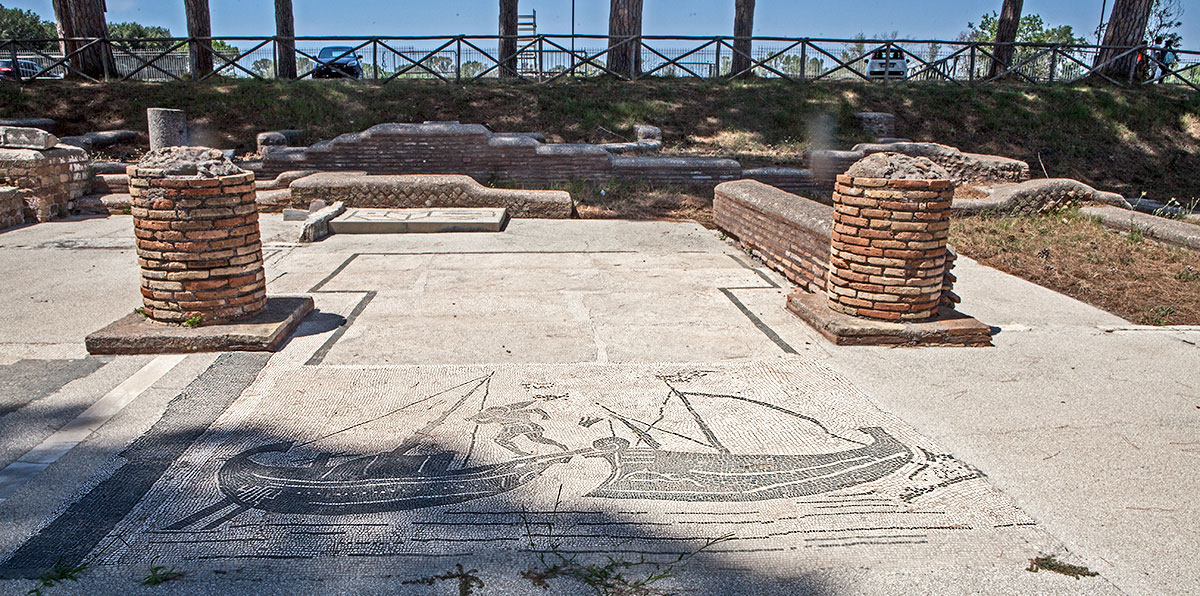
Only under Claudius, however, do we see the first improvements to the harbour infrastructure itself. The most important was the construction of a large harbour basin just inside the mouth of the Tiber, in the western part of Regio III. It was approximately one hundred metres long and eighty metres deep.[4] On its eastern side, a monumental complex of shipsheds (navalia) and a temple was built, giving Ostia an imposing seafront for the first time.
At the same time, storage facilities were improved, both through imperial investment, such as the so-called Grandi Horrea, and through private investment, such as the Horrea of Hortensius. This expansion of the river harbour and the simultaneous start of the construction of Portus under Claudius gave new impetus to Ostia's urban development in the second half of the first century.
In the east, buildings reached the city wall in Regio V, while in the west they spread along the coast in a broad strip apparently extending to the beach outside the wall. The first buildings appeared north of the Tiber, and a road connected Ostia with Portus.
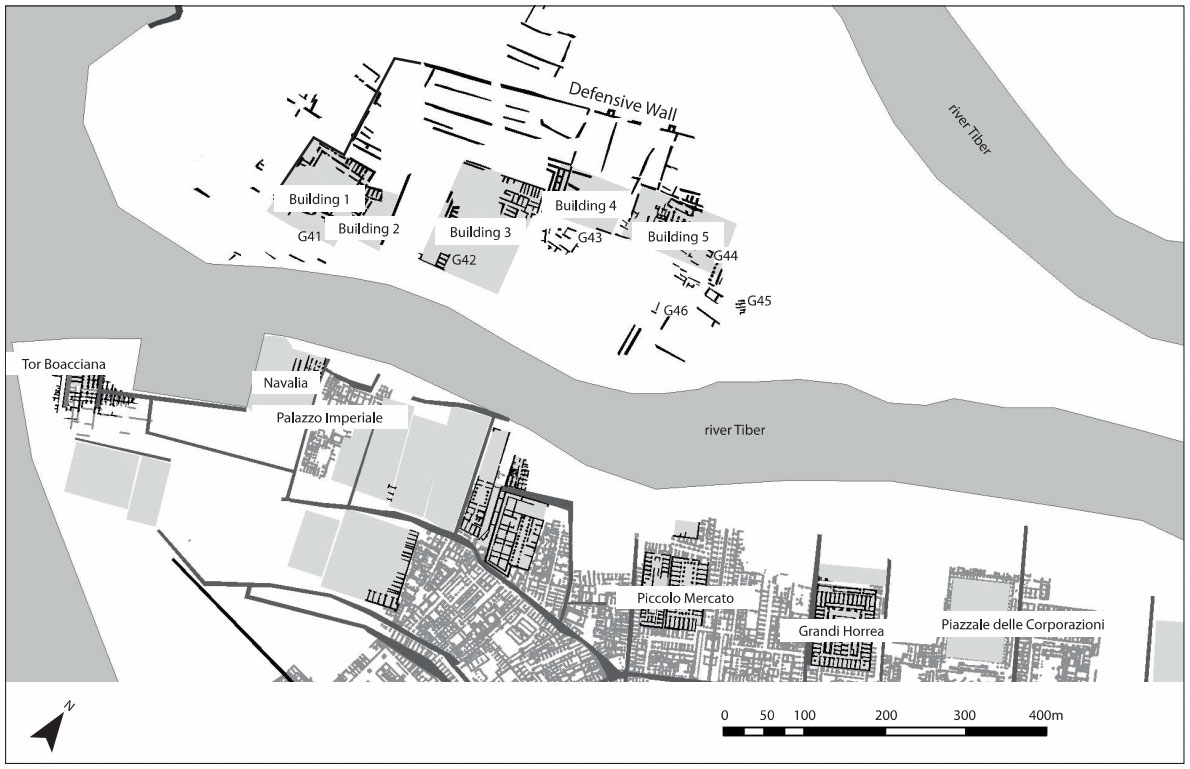
As regards the use of the newly built-up area, two sectors stand out for their particularly dynamic development. On the one hand, from the Flavian period onwards, the number of warehouses (horrea) increased, especially near the harbour basin in the western part of Regio III.
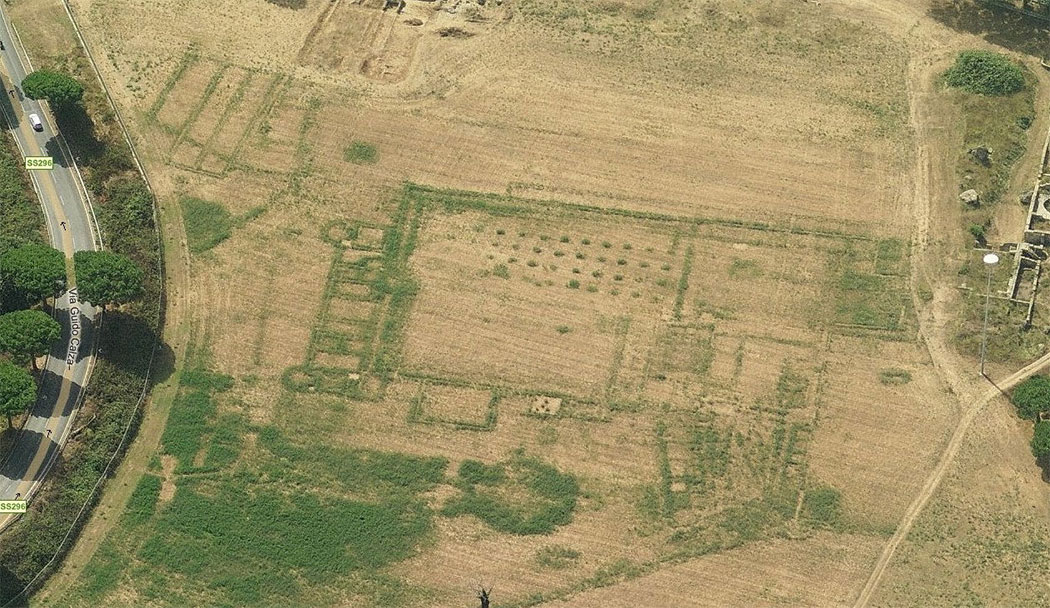
Particularly important, on the other hand, is the first evidence of a row of large, luxurious houses and at least one large villa suburbana6 on the southeastern edge of the city.[5] Three buildings we investigated date from the Flavian period and therefore undoubtedly predate the great urban expansion of the second century. Apparently, a small group of exceptionally wealthy citizens emerged during this period, possibly thanks to the city's growing trade. They left the city centre for the suburbs.
During the second century, Ostia underwent a fundamental urban revival, which the British historian Russell Meiggs7 rightly called an ‘architectural revolution’ and which continues to shape our image of the city today.[6]
While almost all the older structures in the centre were gradually demolished and replaced by new, larger buildings, the city expanded rapidly at its edges. Within a few decades, the built-up area doubled.
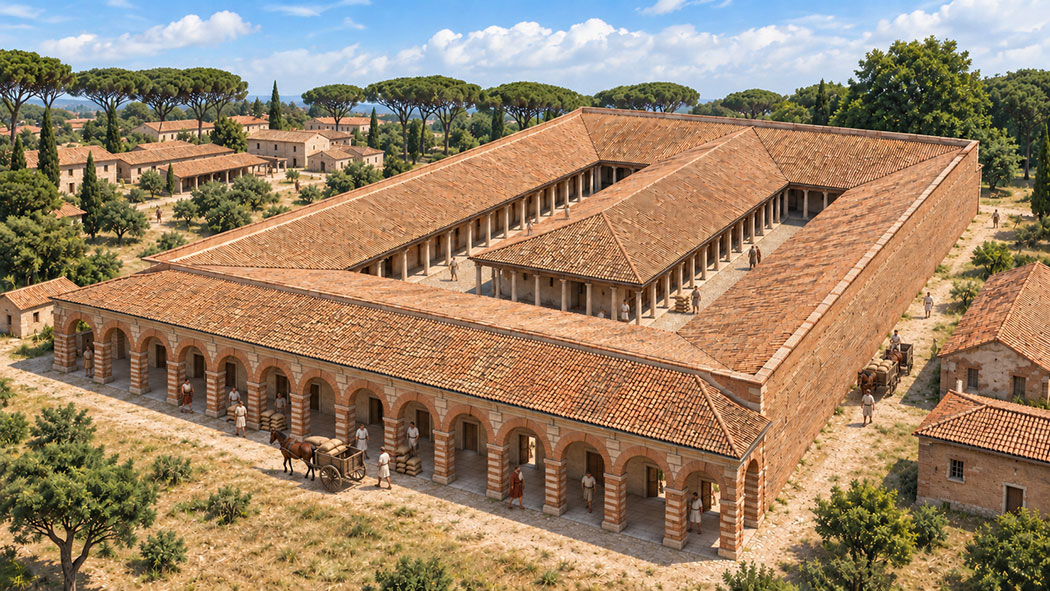
The character of the new districts was strongly determined by commercial utility. The largest category of new buildings consisted of warehouses of widely varying sizes and types, sometimes found even in the most remote parts of the city.[7] Approximately twenty to twenty-five new warehouses must be added to the fifteen known buildings of this type. This doubled the available storage space during the second century.[8]
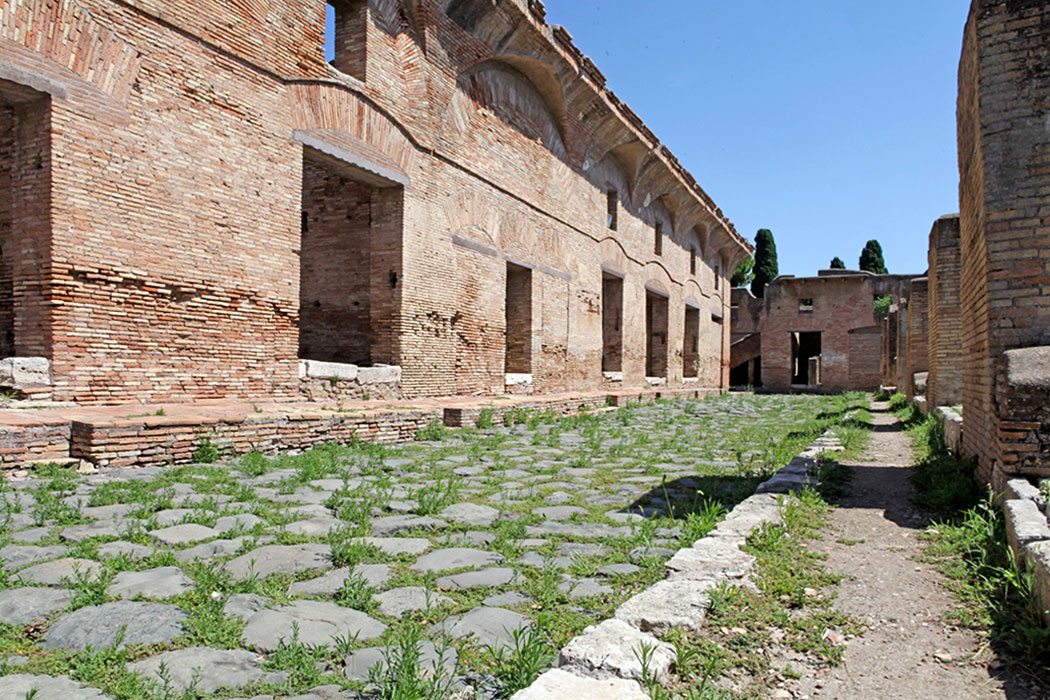
Another category consisted of insulae of varying sizes, which, as multifunctional rental properties, provided investors with a particularly profitable source of income. The ground floors of most insulae served commercial purposes, as did the more than eight hundred tabernae counted in the excavated city centre. It is estimated that this number must again be doubled to account for the unexcavated areas.[9]
The large number and variety of building types and the apparently largely uncoordinated development of individual districts suggest that the city's economic revival was driven primarily by private economic interests. This differs markedly from the systematic expansion of Portus by the emperors.[10]
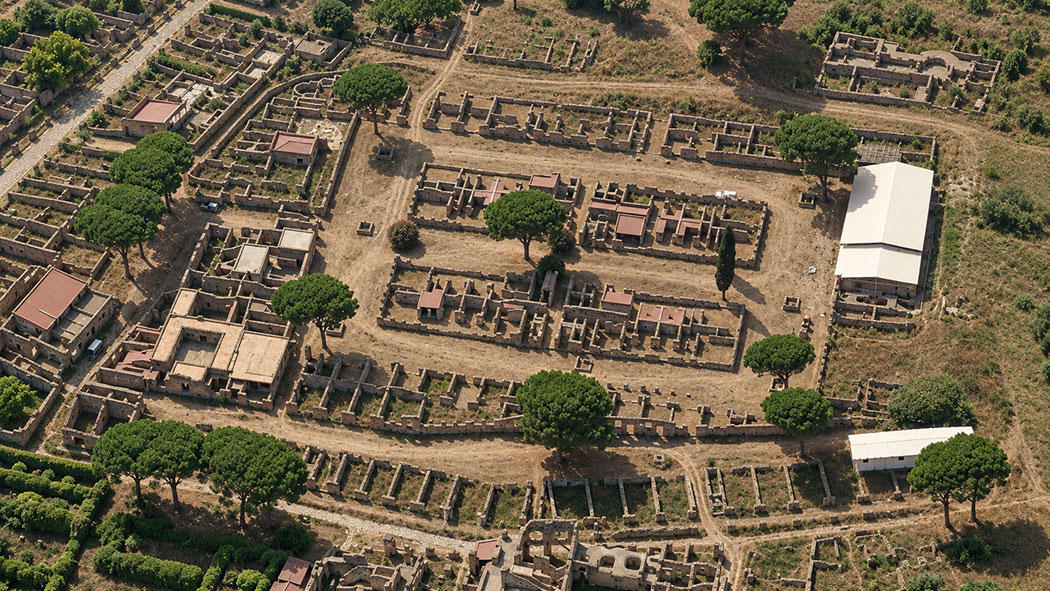
As Janet DeLaine recently demonstrated through an analysis of brick stamps, even large-scale building projects such as the Case a Giardino (houses with a garden) resulted from private investment.[11] We may therefore assume that, as a result of the extraordinarily dynamic economic revival, ownership of real estate in Ostia became highly concentrated in the hands of wealthy investors, while the vast majority of the population lived in rented properties.
Overall, Ostia displays an exceptional and narrowly focused economic boom, unparalleled in the Mediterranean. In the second century, the city and its society were entirely oriented towards trade, but unlike in Portus, this prosperity was sustained mainly by private investors. At the same time, Ostia's economy generated enough surplus to provide work and food for a rapidly growing population. Hundreds of private entrepreneurs, united in professional associations, and thousands of small traders, shopkeepers, craftspeople and labourers kept business running. The result was the formation of a remarkably broad middle class (see: ‘The collegium, the Roman guild').
This incredible economic success did not, however, last long. Through a systematic study of third-century building activity, Carlo Pavolini demonstrated that from the late Severan period onwards, Ostia underwent a severe crisis and profound economic restructuring.[12] None of the warehouses in the excavated areas shows signs of continued use after the middle of the third century.
Five warehouses we investigated during our excavations were even completely abandoned during this period. At least one hundred tabernae in the city centre were abandoned. Many multistorey insulae fell out of use or were reduced in height and converted into smaller residential units. This indicates a dramatic decline in Ostia's population. Particularly telling is the fact that at least one large domus in Regio III and the large villa suburbana in Regio IV were completely abandoned by the end of the third century.[13] The crisis of the third century therefore also seems to have affected those who had benefited from the earlier economic boom.
The earlier development of Ostia, up to the Flavian period, seems readily understandable in terms of its role as a supply port for Rome. By contrast, the exceptional economic success of the second century remains somewhat puzzling. It has long been suggested that it must somehow be connected with the construction of Trajan's harbour and the subsequent transfer of the Alexandrian grain fleet to Portus.[14] So far, however, no truly convincing arguments have been put forward to explain how Ostia would have benefited from this: after all, all goods unloaded in Portus went directly to Rome, without passing through Ostia.
How, then, could Ostia, with a much less efficient harbour system than Portus, nevertheless develop into a flourishing trading centre in its own right?
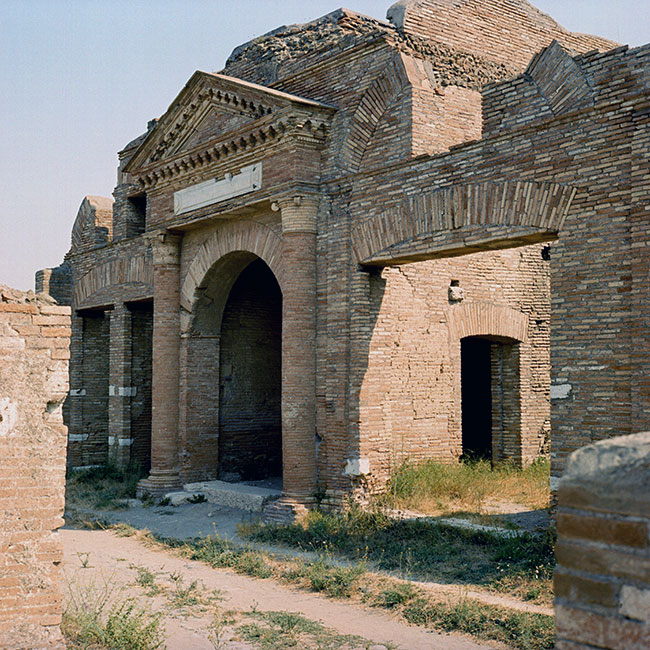
One important explanation may lie in a distinction between the types of goods transshipped in Portus and Ostia.
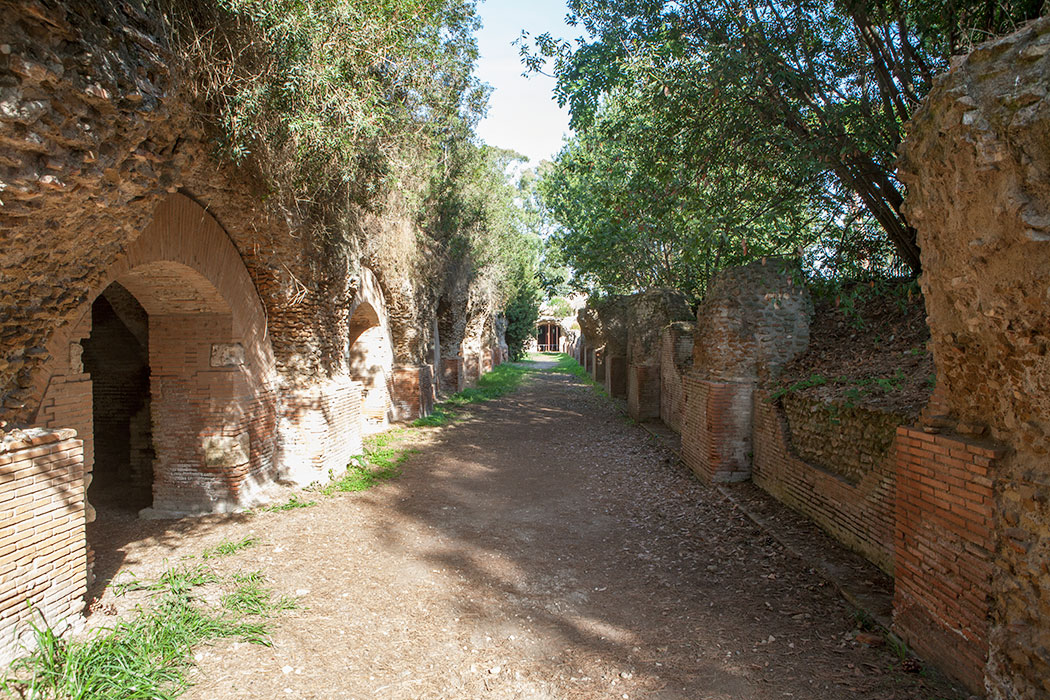
Portus was clearly designed to optimise the supply of daily necessities to Rome within the annona system8, especially grain and later oil.
The preferred type of storage building there was the elongated corridor-type warehouse, which was particularly suitable for the short-term storage of bulk products such as grain.
In Ostia, by contrast, courtyard-type warehouses predominated. Some were richly decorated, apparently with the intention of attracting potential customers.[15] These warehouses were, in fact, more like trading houses than simple storage facilities. It seems likely that these private warehouses traded in other goods, such as luxury products from the East and speciality wines. But why would Romans make the long journey to Ostia to buy those goods there, given that the same variety of warehouse types can be found in Rome itself?
And a second, more important question: why did Ostia only begin to attract such extensive private investment in this sector at the beginning of the second century? I think we can rule out Rome as the decisive stimulus. The consumption of luxury goods by the imperial court and aristocratic households had already reached a peak under Nero and the Flavian emperors. From Trajan onwards, this consumption remained consistently high and continued to increase throughout the second century. Demand from the wider Roman population probably also remained roughly the same. The population of approximately one million did not change substantially between Augustus and the end of the third century, nor did the living conditions of most of the urban population. Where, then, was the market for the enormous quantities of goods stored and traded in Ostia?
There was indeed one large market with rising demand: the cities in the provinces, which experienced an enormous boom in almost every part of the empire during the second century AD. If we turn our attention to them, how can we connect Ostia with that market?
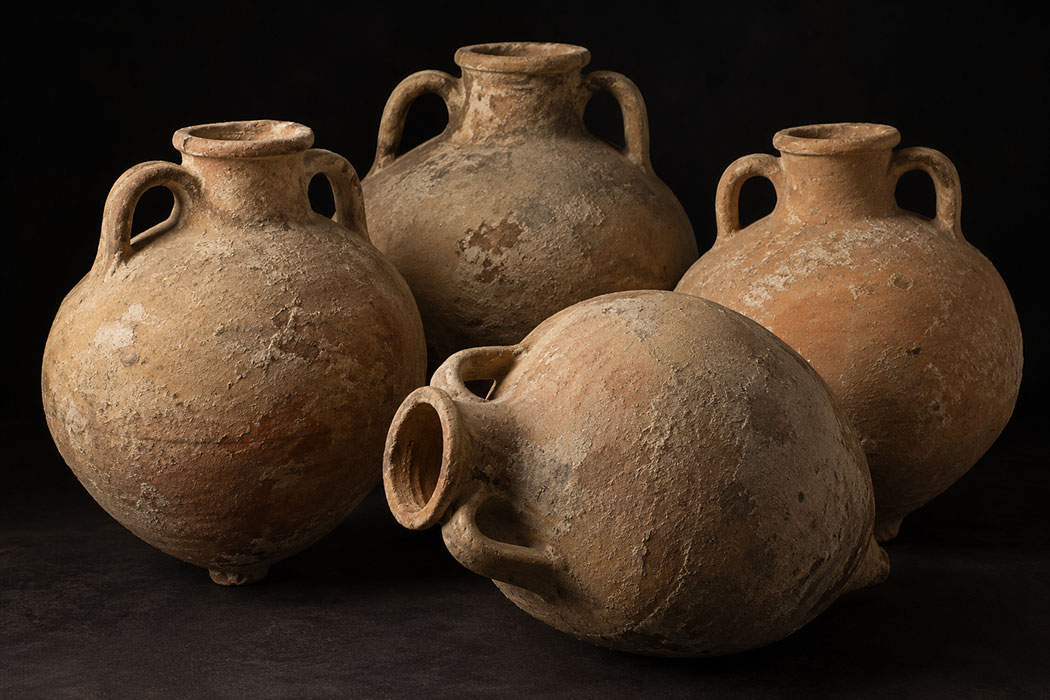
We are all well aware that all kinds of goods were constantly transported across the Mediterranean in every direction. For example, the distinctive Iberian Dressel 20 oil amphora spread far into the East during the first two centuries AD. Conversely, the Kapitän II wine amphora, produced in the eastern Mediterranean, reached Spain, Germania and even Britain from the end of the second century AD onwards.[16] But how exactly did this trade work?
Could Ostia have served as a centre for intermediary trade in these products?
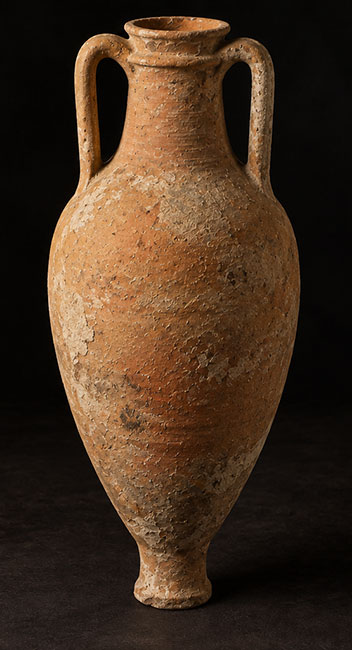
Unfortunately, convincing archaeological evidence for this hypothesis is very difficult to find. Nevertheless, there are a few small indications.
Carlo Pavolini pointed out that Roman sailing ships could not sail without a certain amount of ballast. He therefore suggested that ships departing from Ostia carried goods rather than sand.[17] Goods of unmistakably Roman origin, such as roof tiles and dolia, have indeed been found in many places in the western part of the empire. Although they represent only an extremely small group of products, they prove that at least some outbound trade took place from Ostia. A promising but considerably more complex approach for future research is to compare pottery assemblages from different sites around the Mediterranean.
The sudden and almost simultaneous appearance of certain products in completely different regions, such as early African terra sigillata9 at the beginning of the second century, and their equally sudden disappearance, might, for example, indicate that their distribution depended on a large trading centre with which these regions maintained close contacts.[18]
Finally, if we lack sufficient solid archaeological evidence, we can always turn to theoretical approaches. Modern network theories, particularly the influential ‘small world’ model of Watts and Strogatz,[19] can indeed help explain the phenomenon we observe in Ostia.10
Put simply, this model shows that the most efficient networks consist of a very large number of individual nodes, each connected to neighbouring nodes. In our case, these might be individual port cities, with their hinterlands and neighbouring harbours.
The connectivity of such networks increases greatly when some nodes - but not all - establish long-distance connections, because the distance within the network becomes smaller for these nodes and their neighbours. Beyond a certain level of connectivity, such large nodes, or hubs, naturally attract further connections with smaller nodes and continue to grow.
Economists have now also tested the ‘small world’ network and shown that this is indeed the most efficient way to organise systems of bilateral trade [20]. This has also demonstrated that, in an ideally organised trading system, most participants trade exclusively at a local level, while only a few, concentrated in the large nodes, handle long-distance trade and subsequent distribution to local markets.
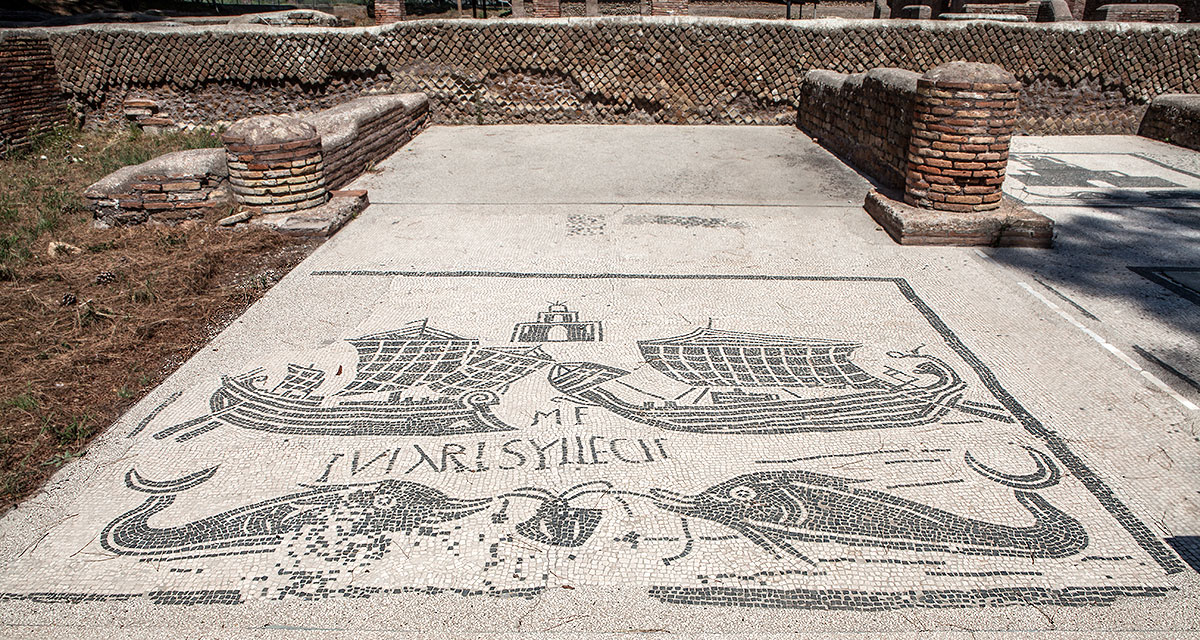
Returning to Ostia: I think this ‘small world’ network approach can explain very well what happened during the second century AD. Before the construction of Trajan's Portus, Ostia already had close ties with the West. It imported large quantities of Iberian oil and fish sauce and Gallic wine. However, because goods from the East and South were unloaded in Puteoli, these two different trade connections could not be linked together. This changed only when Trajan's harbour attracted ships from the East.[21] From that moment onwards, Ostia was ideally placed to function as a centre for intermediary trade between East and West. Incoming ships could first unload the goods covered by the annona in Portus and then sail on to Ostia. There they could unload private merchandise, do business with local intermediaries on the Piazzale delle Corporazioni and finally take on new cargo for their destinations on the return voyage.
Why, then, did this successful network system break down so drastically in the first half of the third century? I can envisage several reasons. First, demand for luxury goods in Rome declined during this period. Second, the availability of these goods may have been affected by wars in the East, although we tend to overestimate the impact of political events on trade routes. A more important factor may have been that imports of oil from Spain, previously organised exclusively by private entrepreneurs, increasingly came under state supervision under the Severan emperors. This must have had adverse consequences for the economic activities of private investors and entrepreneurs in Ostia.[22] Oil imports from Iberia did indeed come to a complete halt in the middle of the third century AD and had by then been replaced by imports from North Africa. With the loss of this important western trade connection, the previously established balance between the connections was disrupted. This may have heralded the end of Ostia as the marketplace of the Mediterranean.
- Heinzelmann's Notes
- [1] General: MEIGGS 1973; RICKMAN 1980; PAVOLINI 1986b; GARNSEY 1988; SIRKS 1991; VIRLOUVET 2000.
- [2] HEINZELMANN and MARTIN 2000, 277-283; HEINZELMANN 2001, 313-328; HEINZELMANN 2002b, 225-242;225-242;
- [3] ARNOLDUS-HUYZENDVELD and PAROLI 1995, 383-392; ARNOLDUS-HUYZENDVELD and PELLEGRINO 2000, 219-226; LE GALL 2005, 13-23.
- [4] HEINZELMANN and MARTIN 2002, 5-19.
- [5] HEINZELMANN 2002b, 225-242.
- [6] MEIGGS 1973, 133-145.
- [7] RICKMAN 1971, 15-86.
- [8] See also KEAY's contribution in this session.
- [9] GIRRI 1956, 7-44; HEINZELMANN 2005, 113-128, with fig. 2.
- [10] HEINZELMANN 2002a, 103-122; DELAINE 2005, 29-47; KEAY et al. 2005, 281-290, 305-314.
- [11] DELAINE 2002, 41-102.
- [12] PAVOLINI 1986a, 239-283; PAVOLINI 2002, 325-352.
- [13] HEINZELMANN 2002b, 225-242.
- [14] MEIGGS 1973, 278-285.
- [15] HEINZELMANN 2002a, 103-222; DELAINE 2005, 29-47.
- [16] PANELLA 1985, 180-189; REYNOLDS 1995, 106-110.
- [17] PAVOLINI 1985, 200-208.
- [18] REYNOLDS 1995, 6-14, with fig. 152-154.
- [19] WATTS and STROGATZ 1998, 440-442.
- [20] WILHITE 2001, 49-64.
- [21] Keay also discusses the diversion of the Alexandrian grain fleet from Puteoli to Portus in this session.
- [22] REYNOLDS 1995, 106-108.
Editorial Notes- 1: Castrum – Roman military camp
- 2: Ground investigation for archaeological traces
- 3: See article “Overseas trade”
- 4: Drawing by Michael Heinzelmann
- 5: Keay 2020, fig. 6.6.
- 6: Luxurious Roman country house
- 7: Russell Meiggs: Roman Ostia – 1960
- 8: Annona – Heavily subsidised or free grain supply for the population of Rome.
- 9: Terra sigillata – Very fine glossy brown/red Roman pottery.
- 10:Small-world model: a mathematical network model showing how your own local network can simultaneously be connected, through each individual in that network, to that other individual's network.
Bibliography- oARNOLDUS-HUYZENDVELD A. and PAROLI L., 1995. Alcune considerazioni sullo sviluppo storico dell’ansa del Tevere presso Ostia. Archeologia Laziale, 12, 383-392.
- oARNOLDUS-HUYZENDVELD A. and PELLEGRINO A., 2000. Development of the Lower Tiber Valley in historical times. Memorie descrittive della Carta Geologica d’Italia, 54, 219-226.
- oBRUN J.P., 2003. Le vin et l’huile dans la Méditerranée antique. Paris. oDELAINE J., 2002. Building activity in Ostia in the second century AD. In C. BRUUN and A. GALLINA ZEVI (eds.), Ostia e Portus nelle loro relazioni con Roma (Acta Instituti Romani Finlandiae, 27), 41-102.
- oDELAINE, J. 2005. The commercial landscape of Ostia. In A. MACMAHON and J. PRICE (eds.), Roman Working Lives and Urban Living. Oxford, 29-47.
- oGIRRI G., 1956. La taberna nel quadro urbanistico e sociale di Ostia.
- oHEINZELMANN M., 2001. Ostia. Vorbericht zur dritten Grabungskampagne 2000. Roemische Mitteilungen, 108, 313-328.
- oHEINZELMANN M., 2002a. Bauboom und urbanistische Defizite - zur staedtebaulichen Entwicklung Ostias im 2. Jh. In C. BRUUN and A. GALLINA ZEVI (eds.), Ostia e Portus nelle loro relazioni con Roma (Acta Instituti Romani Finlandiae, 27), 103-122.
- oHEINZELMANN M., 2002b. Ostia. Vorbericht zur vierten Grabungskampagne 2001. Roemische Mitteilungen, 109, 225-242.
- oHEINZELMANN M., 2005. Die vermietete Stadt. Zur Kommerzialisierung und Standardisierung der Wohnkultur in der kaiserzeitlichen Großstadtgesellschaft. In R. NEUDECKER (ed.), Lebenswelten. Bilder und Raeume in der roemischen Kaiserzeit. Wiesbaden, 113-128.
- oHEINZELMANN M. and MARTIN A., 2000. The joint AAR-DAI research project at Ostia – 1998 and 1999 Seasons. Memoirs of the American Academy in Rome, 45, 277-283.
- oHEINZELMANN M. and MARTIN A., 2002. River port, navalia and harbour temple at Ostia: new results of a DAIAAR Project. Journal of Roman Archaeology, 15, 5-19.
- oKEAY S., MILLET M., PAROLI L. and STRUTT K. (eds.), 2005. Portus. An Archaeological Survey of the Port of Imperial Rome (Archaeological Monographs of the British School at Rome, 15). London.
- oLE GALL J., 2005. Il Tevere. Fiume di Roma nell’antichità (second edition). Roma.
- oMARTIN A. and HEINZELMANN M., 2002. The Urbanistic Project on the Previously Unexcavated Areas of Ostia (DAI-AAR 1996-2001). Memoirs of the American Academy in Rome, 47, 259-304.
- oMEIGGS R., 1973. Roman Ostia (second edition). Oxford.
- oPANELLA C., 1985. Il commercio di Roma e di Ostia in età imperiale (secoli I-III): le derrate alimentari. In C. PAVOLINI (ed.), Misurare la terra: centuriazione e coloni nel mondo romano. Città, agricoltura commercio: materiali da Roma e dal suburbio. Modena, 180-189.
- oPANELLA C. and TCHERNIA A., 1994. Produits agricoles transportés en amphores. L’huile et surtout le vin. In L’Italie d’Auguste à Dioclétien (CERF, 198), 145-165.
- oPAVOLINI C., 1985. I commerci di Roma e di Ostia nella prima èta imperiale: merci d’accompagno e carichi di ritorno. In C. PAVOLINI (ed.), Misurare la terra: centuriazione e coloni nel mondo romano. Città, agricoltura, commercio: materiali da Roma e dal suburbio. Modena, 200-208.
- oPAVOLINI C., 1986a. L’edilizia commerciale e l’edilizia abitativa nel contesto di Ostia tardoantica. In A. GIARDINA (ed.), Società e impero tardoantico II: Roma. Politica, economia, paesaggio urbano. Roma, 239-283.
- oPAVOLINI C., 1986b. La vita quotidiana a Ostia. Bari.
- oPAVOLINI C., 2002. La trasformazione del ruolo di Ostia nel III sec. d.C. MEFRA, 114, 325-352.
- oREYNOLDS P., 1995. Trade in the Western Mediterranean, AD 400-700: The ceramic evidence (BAR IS, 604). Oxford.
- oRICKMAN G.E., 1971. Roman Granaries and Store Buildings. Cambridge.
- oRICKMAN G.E., 1980. The Corn Supply of Ancient Rome. Oxford.
- oSIRKS A.J.B., 1991. Food for Rome: the Legal Structure of the Transportation and Processing of Supplies for the Imperial Distributions in Rome and Constantinople. Amsterdam.
- oVIRLOUVET C., 2000. L’approvvigionamento di Roma imperiale: una sfida quotidiana. In E. LO CASCIO (ed.), Roma imperiale. Una metropoli antica. Roma, 103-135.
- oW ATTS D.J. and STROGATZ S.H., 1998. Collective dynamics of “small-world” networks. Nature, 393, 440-442.
- oW ILHITE A., 2001. Bilateral Trade and “Small-World“ Networks. Computational Economics, 18, 49–64.

 We are committed to providing versions of our articles and interviews in several languages, but our first language is English.